
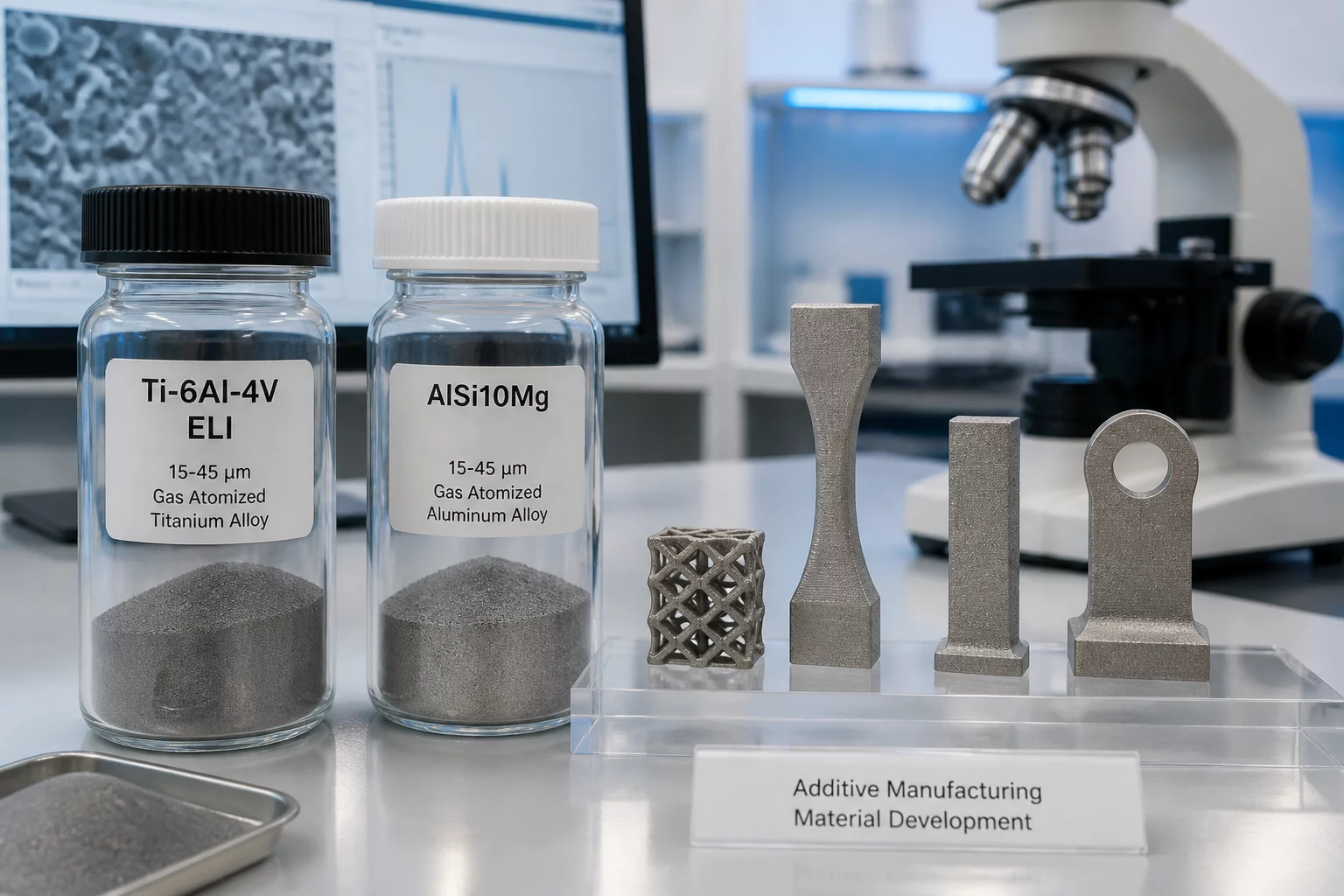
The 2026 industry review of additive manufacturing materials reveals significant breakthroughs in metal alloys, specifically focusing on beta-titanium, heat-resistant aluminum, and ultra-high-strength steels. These advancements provide engineers with higher ductility, thermal stability up to 300°C, and tensile strengths exceeding 1500 MPa, effectively solving long-standing issues with thermal cracking and brittleness in 3D-printed parts.
The Evolution of Beta-Titanium Alloys
Standard Ti-6Al-4V has long been the industry workhorse, but its limitations in ductility for complex, thin-walled structures have hampered its use in critical load-bearing aerospace parts. The beta-titanium alloys highlighted in this review utilize specialized alloying elements that stabilize the beta phase at room temperature. This change in crystalline structure results in a material that maintains high strength while offering significantly improved elongation. In practical terms, this allows for the production of parts that can better withstand impact and cyclic stress without immediate failure, providing a larger safety margin for flight-critical hardware.
High-Temperature Stability in Aluminum
For decades, 3D-printed aluminum was relegated to non-structural or low-temperature housings because it lost its strength rapidly above 150°C. The review introduces a revolutionary heat-resistant aluminum alloy that incorporates scandium and zirconium. These elements create a fine dispersion of secondary phase particles that pin grain boundaries during printing and post-processing. It retains over 80% of its yield strength at temperatures up to 300°C. This makes it a direct competitor to much heavier and more expensive nickel-based alloys for engine components and high-performance heat exchangers.
Ultra-High-Strength Steel Innovations
Steel remains the preferred choice for heavy-duty industrial fasteners and tooling, but high-strength grades are notoriously difficult to print without significant residual stress and cracking. The new ultra-high-strength steel reviewed here has a tailored chemical composition designed specifically for the cooling rates of Laser Powder Bed Fusion (LPBF). It achieves tensile strengths above 1500 MPa after a simplified two-stage heat treatment. Its resilience makes it suitable for lightweighting large-scale industrial machinery where every kilogram saved translates into energy efficiency and reduced operational costs.
"We are no longer just printing parts; we are now printing materials with properties that were once thought impossible for additive processes. These three alloys represent a fundamental shift in how we approach structural design."
Future Outlook for Industrial Implementation
As these materials move from beta testing to industrial production, the focus shifts to process repeatability and certification standards. The review concludes that while the material properties are impressive, successful implementation requires a deep understanding of machine-specific parameters. Companies adopting these materials are encouraged to perform localized validation of build files to ensure the intended mechanical properties are achieved across the entire build envelope.